


If you want to roll into 2027 stronger, the off-season starts with knowing your true baseline. Predictive algorithms and online calculators rely on estimates to guess metrics like VO2 Max and FTP. Direct lab testing cuts through the noise, giving you precise physiological benchmarks so every winter workout actually moves the needle.
Through the Performance Health Analysis (PHA) program at CSU’s Human Performance Clinical Research Lab (HPCRL), local riders have direct access to research-grade metabolic carts, lactate threshold analysis, and clinical DEXA scans—complete with expert guidance to turn raw numbers into an actionable training plan.
Special Offer: Mention this article to receive a 15% discount on your initial service.
Note: The following information was provided by the Human Performance Clinical Research Lab at Colorado State University.
Performance Health Analysis | Human Performance Clinical Research Lab, Colorado State University
Whether you are preparing for a big race or event, or want a baseline to measure your health and longevity, the Performance Health Analysis (PHA) program at Colorado State University’s Human Performance Clinical Research Lab (HPCRL) has a test for you. From VO2 Max, Zones determination, and Lactate Threshold, or wanting to know your body composition via a DEXA, BOD POD, or resting metabolic rate test, CSU’s PHA has you covered. Anyone can book a test to experience scientific, evidence-based testing conducted under physician oversight.
What makes HPCRL different
Public access to a working clinical research lab is exceptionally rare. The HPCRL is one of the only few facilities in Northern Colorado offering public assessments using gold-standard, research-grade equipment, including PARVO metabolic carts and the Hologic Horizon A DEXA. With dedicated physician oversight, we guarantee that all testing meets the highest clinical standards for safety and data integrity.
Although raw data is only half of the equation; the PHA team takes the time to walk you through what your data from the test mean. From competitive cyclists to those simply wanting to know where they stand, we translate clinical data into a practical, and actionable plan.
Why measured numbers matter
Most training devices and online calculators don’t actually measure VO2Max or FTP; they estimate them using algorithms that are easily skewed by heat, caffeine, fatigue, and altitude. True physiological thresholds don’t shift day to day like these devices’ algorithms and calculators suggest. Our PARVO metabolic cart, which is used in VO2max and Training Zones Determination testing, bypasses this guesswork by directly analyzing your gas exchange. By cross referencing metabolic data with blood lactate, heart rate, and RPE, the PHA team pinpoints your actual VO2Max, FTP, and training zones.
Smart scales and predictive equations also offer an unreliable snapshot of your body composition, as they rely heavily on weight and surface-level estimations. In contrast, a clinical DEXA scan provides a precise breakdown, directly differentiating lean mass, fat mass, and bone density with over 98% accuracy.
Whether you are targeting threshold improvements for a race, losing weight to climb faster, or determining your baseline; direct lab testing with our research-grade equipment delivers precise readings.
Testing and Services
-
VO2Max. The VO2Max test determines the maximum amount of oxygen your body can use during exercise, and your standard measure of aerobic capacity. Low aerobic fitness carries a risk of early death comparable to smoking or diabetes, which is why this test attracts plenty of people with no interest in racing. For cyclists, repeating it each year shows whether training is actually increasing your VO2Max.
-
Training Zones Determination. A Training Zones Determination Test combines both a Lactate Threshold test and a VO2Max test to find exact values for power at different intensities. By cross referencing several different metrics we can determine exact training zones for your physiology. This ensures cyclists are at the right intensity for specific training adaptations.
-
Lactate Threshold. A test that measures intensity at which lactate starts accumulating faster than your body can clear it. Mostly used by endurance athletes to set training intensity, but useful for anyone who wants effort levels based on physiology rather than feel. As well as how well your body can utilize lactate as fuel.
-
Coaching. Cycling coaching is offered to help you achieve your goals. PHA offers coaching that integrates test results with structured training plans tailored to each client’s physiology and goals.
-
DEXA Scan. Lean mass, fat mass, and bone mass broken out by region of the body. A scale tells you your weight changed; a DEXA tells you exactly where and what kind of weight moved.
-
Resting Metabolic Rate. How many calories your body burns at rest. Online calculators estimate this from height, weight, and age, and individual variation is wide enough that the estimate is often well off. Useful for anyone building a weight management or fueling plan, and for endurance athletes trying to avoid under-fueling during heavy training blocks.
-
Bod Pod. Body composition measured by air displacement. Quick, non-invasive, and affordable for regular tracking.
 Who these tests are for
 Who these tests are for
Whether targeting a local crit or an endurance gravel race, cyclists of all levels rely on exercise and metabolic testing to eliminate the guesswork. Tracking VO2 max, blood lactate, training zones, and body composition throughout the season provides a clear window into your evolving fitness. Because your physiology shifts year-round, periodic testing ensures your daily training loads and intensities stay aligned with your actual metabolic profile and goals.
Local Athletes Already Taking Advantage
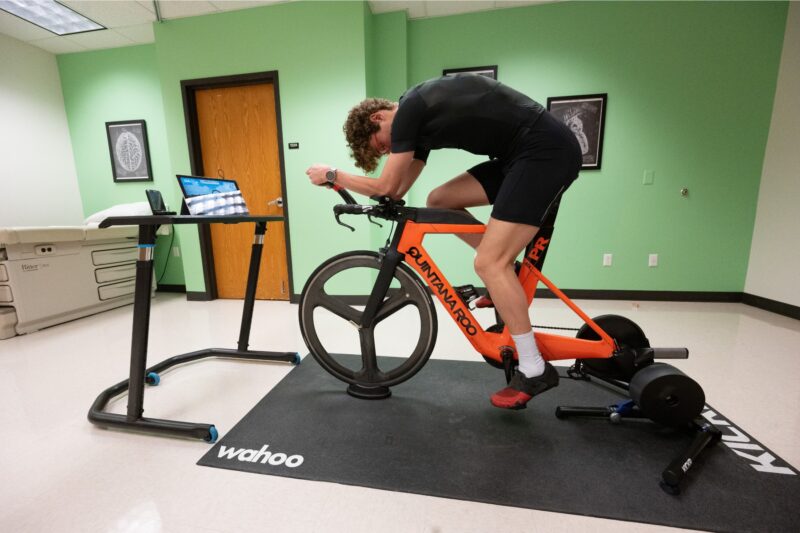
Many local athletes have already utilized our services to benchmark their fitness, guide off-season training, or refine their training strategies. Our program’s testing has supported high-level athletes preparing for events like the US Mountain Running Championships and student athletes seeking a competitive edge over their peers. Most cyclists are using wearable tech to monitor rides, but these measurements are not always accurate. An exercise physiologist will translate the data generated from VO2Max, Lactate Threshold, or Training Zones Determination tests into personalized, easy-to-understand results. This ensures that you are making the most of each and every training session and not logging “junk miles.” The HPCRL Wahoo Kickr also allows cyclists to bring in their own bike (if compatible) to ensure the most realistic results possible.
The team ensures every client receives a detailed report within 7 business days after testing. Each report includes charts, data interpretation, and personalized notes. Clients can also schedule free consultations before or after testing to discuss results and ask follow-up questions or questions about the test itself.
“E-V-E-R-Y-T-H-I-N-G! Professional without being stuffy or dry, enthusiasm of the entire staff, cleanliness and ease of parking, thoroughness of the test itself (explanations, constantly being asked if I had questions/was doing alright while on the equipment) and not being rushed out the door afterwards. The CSU Human Performance Lab sets the bar on how EVERYTHING should be done!”
— (2026 Training Zones Determination Client)
Staff
When YourGroup Ride first introduced Performance Health Analysis in 2019, Dr. Scott Fahrner was helping bring the program to life. Now, the PHA team at CSU is excited to welcome its co-founder back as the Human Performance Clinical Research Lab’s Supervising Physician.
With decades of medical experience and a lifelong background in endurance sports, Scott brings valuable clinical and practical expertise to the team and helps uphold high standards for client safety. He works alongside HPCRL Director of Research Operations and PHA co-founder Laurie Biela, who provides strategic oversight and helps guide the program’s direction and development.
PHA Clinical Coordinator Genevieve Kalb oversees day-to-day operations, with a focus on high-quality testing and client services. She also supports ongoing research within the HPCRL, helps translate research findings into practical applications, and coordinates community outreach efforts.
The team is also pleased to welcome PHA Research Assistant Jacob Hyde, who supports testing and client services alongside Genevieve. Administrative Coordinator Jessi Granzow rounds out the team, supporting scheduling, client communication, and the administrative operations that keep PHA running smoothly.
Together, the team provides individualized, evidence-based physiological testing and coaching for athletes and community members seeking to better understand and improve their health and performance.
How to Schedule a Test
Mention this article to receive a 15% discount on your initial service.
We offer testing year-round and work with you to find appointment times that fit your schedule. Booking can be completed via phone or directly through our website. Whether aiming for the top step of the podium, optimizing workout efficiency, or seeking deeper insights into personal health, PHA delivers an evidence-based pathway to elevated performance and wellness across the community.
-
Location: 910 Moby Drive, Fort Collins, CO 80521 (East of Moby Arena)
-
Website: HPCRL Performance Health Analysis
-
Phone: (970) 491-6120
If you enjoy this content and appreciate the hustle that goes into YGR please consider supporting the site.