

It’s chip seal season!. If you’ve ridden the dams, Masonville, or headed up to Lory State Park or Horsetooth Mountain Open Space lately, you’ve experienced it firsthand. As much of a PITA as chip seal is, it’s also a necessary evil that helps extend the life of our roads and saves taxpayers money. I checked in with Todd Juergens, Road and Bridge Director for Larimer County, to answer the questions cyclists ask every summer, from why roads are chip sealed and how much it costs to how long the loose gravel lasts and what the County does to minimize impacts on riders. Read the Q & A below.
Stay up to date on upcoming road closures here.
For readers who may not be familiar with it, what exactly is chip seal, and what does it accomplish?
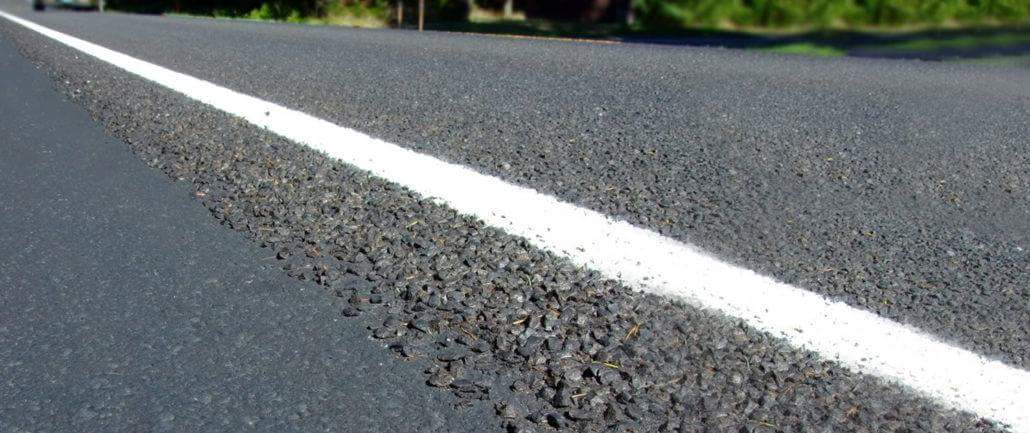
Chip sealing is a highly effective pavement maintenance technique. It involves applying a layer of liquid asphalt emulsion (oil) to a road, followed by a layer of small crushed stone (aggregate, or “chips”).
It accomplishes two key goals:
- Protection: The emulsion seals minor cracks and protects existing pavement from sun degradation and water penetration.
- Durability: The crushed aggregate creates a new wearing course that restores friction and extends the road’s overall life.
How many paved miles does Larimer County Road & Bridge maintain?
Larimer County maintains 463 centerline miles of paved roads (a centerline mile measures the physical length of the road, regardless of the number of lanes).
This total includes:
- 380 miles of mainline county roads
- 83 miles of subdivision roads
Roughly how many miles of roadway are chip sealed each year?
We chip seal between 35 and 57 centerline miles each year.
Larimer County is divided into 9 maintenance zones, starting with Zone 1 in the Estes Park area and moving north to Zone 9 in the Red Feather Lakes area. Because roadway mileage isn’t divided equally across zones, the annual mileage varies.
How do you determine which roads are selected for chip seal in a given year?
Because Larimer County spans 2,640 square miles, dividing our paved network into 9 geographic zones allows us to run an efficient, cost-effective maintenance schedule.
Each year, we focus on all paved roads within a designated zone. We assess pavement conditions across the county every two years. Prior to a zone’s scheduled chip seal year, we review the most recent condition data. Roads selected for treatment are those at the ideal stage where chip sealing will preserve structural integrity and where no major structural work or reconstruction is planned in the near future.
Why is chip sealing typically done during the summer months? Are there temperature or weather requirements?
Chip sealing requires warm to hot temperatures and dry conditions. High heat and low humidity allow the liquid asphalt emulsion to cure rapidly, bond tightly with the aggregate chips, and create a durable, waterproof seal before heavy traffic resumes.
How much does it cost to chip seal a mile of roadway compared to completely repaving that same mile?
Costs vary based on road width, but our recent average unit costs are:
- Chip Seal: ~$4.50 per square yard
- Asphalt Overlay: ~$22.50 per square yard
For a typical 1-mile stretch of two-lane road (24 feet wide):
- Chip Seal: ~$63,000
- Asphalt Overlay: ~$317,000 (roughly 5 times more expensive)
Aside from cost, adding asphalt overlays everywhere isn’t ideal engineering or pavement management practice:
- Overlay thickness: Adds ~3 inches to the road height. This requires adding gravel to shoulders, which makes roadside slopes steeper and causes long-term drainage and safety issues.
- Chip seal thickness: Adds only ~½ inch, preserving existing roadside drainage and eliminating the need for extra shoulder gravel.
How long does a chip seal treatment typically last?
A well-applied chip seal routinely lasts 9 years, which aligns with our 9-zone rotation schedule.
How many times can a road be chip sealed before it needs a full overlay or reconstruction?
It depends on traffic volume and percentage of heavy trucks.
High-traffic roads: Perform well for 3 to 4 applications. Beyond that, heavy traffic pushes stone down into the lower layers, causing asphalt oil to flush to the surface, which can reduce tire traction/skid resistance.
Lower-volume roads: Perform well for 5 or more applications.
If roads were never chip sealed or preserved, how much sooner would they require complete replacement?
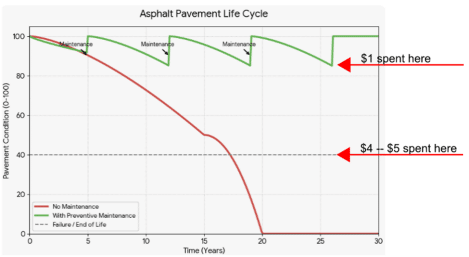
While there isn’t a single number for every road, pavement research consistently shows that timely preventative maintenance drastically extends road life.
Chip seal is part of our broader Pavement Management Program that includes crack sealing, fog seals, slurry seals, structural patching, and overlays. Applying the right treatment at the right time prevents minor surface defects from escalating into full road failures.
From an asset management standpoint, how much money does preventive maintenance like chip sealing save taxpayers over the long term?
Preventative maintenance resets the aging clock of a road. Research shows that every $1.00 spent on timely preventative maintenance saves $4.00 to $5.00 in future reconstruction costs.
While every road eventually reaches the end of its structural lifespan and requires replacement, treatments like chip sealing push that costly milestone decades into the future.
Cyclists often notice loose gravel immediately after chip sealing. Can you explain what happens during that curing process and why the loose rock is necessary?
The process begins by spraying a liquid asphalt emulsion onto the roadway, immediately followed by spreading aggregate on top of the emulsion, and finally rolling the aggregate to embed it into the emulsion.
To ensure complete coverage with no bare spots, a small percentage of extra aggregate is intentionally applied. A small amount of loose rock is a normal part of the process, not a sign of poor quality work.
Once the emulsion cures enough to withstand sweeping without pulling up embedded stones (typically within 24 hours), the excess rock is swept off the road.
How long does it typically take before the surface is swept and becomes more bicycle friendly?
Excess aggregate is typically swept off the road within 24 hours of application.
Are there any steps Road and Bridge takes specifically to minimize impacts on cyclists, such as scheduling, sweeping priorities, signage, or coordinating with local cycling groups?
- Paved Shoulder Preservation: On roads with paved shoulders 4 feet wide or greater, we leave the shoulders unchipped whenever possible. Instead, shoulders receive a thin liquid sealant, preserving a smoother ride for cyclists while providing some level of protection for the asphalt.
- Prompt Sweeping: We sweep loose chips as soon as the asphalt binder cures sufficiently. This improves rideability for bikes and vehicles while preventing loose stones from dislodging embedded gravel.
- Public Notifications: We communicate project schedules via electronic message boards, road signage, press releases, our Road Event Status System (RESS), and social media updates. We depend on these tools to inform all modes of travel equally.
- Scheduling: We do not schedule chip seal work Friday-Sunday or around summer holidays in areas that see high recreational use. The exception to this would be sweeping occurring on a Friday for a chip seal that was applied on Thursday.
What advice would you give cyclists who encounter a freshly chip sealed road?
- Slow Down: Adjust your speed to match road conditions. Loose aggregate can reduce traction and handling.
- Consider Rerouting: Fresh work zones can stretch for several miles. If possible, consider an alternate route until sweeping is complete.
- Watch for Equipment: Pay extra attention to pilot cars, haul trucks, and rollers in work zones. Always yield if uncertain.
Are there any misconceptions about chip sealing you’d like to clear up?
Misconception 1: “Chip seal maintenance is a ‘cheap, temporary fix’ and only used because the County cannot afford real asphalt.”
Reality: Chip seal is an engineered product, with a high return on investment that protects the pavement from degradation caused by atmospheric conditions and surface wear caused by traffic. When applied to the right road at the right time, it drastically extends the pavement’s life span.
Misconception 2: “Using smaller or smoother gravel would be better for bikes and perform just as well.”
Reality: Aggregate size and shape are critical to this engineered product.
- Stone Size: Aggregate must be embedded 50–70% deep into the asphalt emulsion. Larger aggregate allows for a thicker asphalt seal, providing greater protection and longevity.
- Stone Shape: Smooth or rounded river gravel pops out under car tires. We use clean, angular-cut stone that interlocks tightly and locks into the asphalt layer under traffic pressure.
If you enjoy this content and appreciate the hustle that goes into YGR please consider supporting the site.