
A newly passed federal law has placed a spotlight on Northern Colorado trails, explicitly naming a conceptual 90-mile Poudre Canyon route as a national priority area for long-distance bicycle trail development.
The Expanding Public Lands Outdoor Recreation Experiences (EXPLORE) Act was signed into law on January 4, 2025. Contained within Section 121 of the package is the Biking on Long-Distance Trails (BOLT) Act. The legislation requires federal land management agencies to identify 10 existing long-distance bike routes of at least 80 miles, alongside 10 “opportunity areas” with clear potential to establish or complete new long-distance routes.
In a newly published report by the national BOLT Coalition, an advocacy alliance comprising the International Mountain Bicycling Association (IMBA), Bikepacking Roots, and PeopleForBikes, the Tour de Poudre in the Roosevelt National Forest was officially submitted as one of the 13 national candidates for “Potential Long-Distance Trails.”
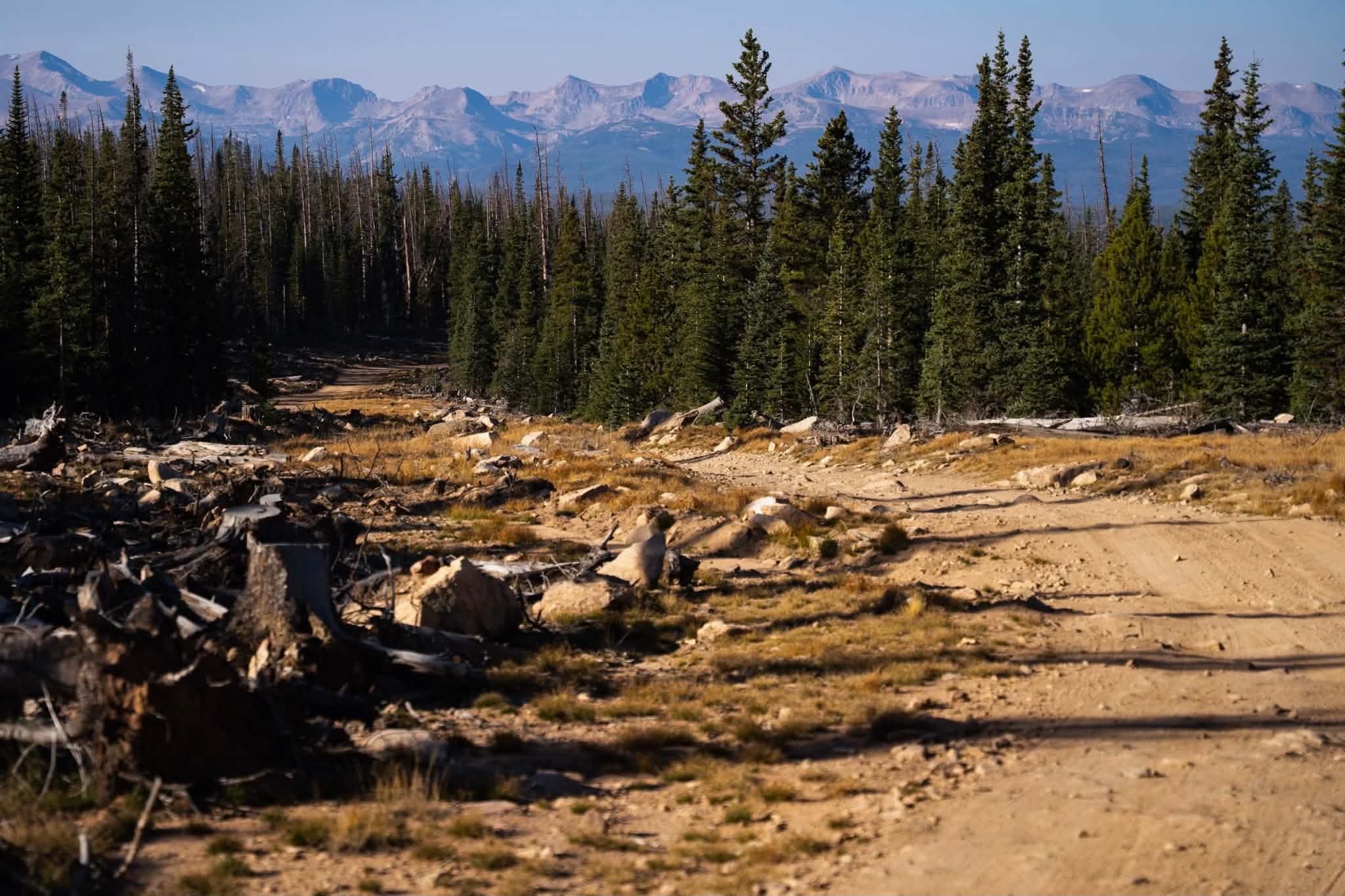
The Tour de Poudre does not currently exist as a contiguous, signposted, or widely rideable route. It is a proposed framework to stitch together 90 miles of existing U.S. Forest Service (USFS) fire roads and established singletrack networks up the Poudre Canyon.
| Route Metric | Status |
| Projected Distance | 90 Miles (When complete) |
| Current Status | Fragmented / Non-contiguous |
| Surface Profile | Mix of dirt forest roads and singletrack |
| Jurisdiction | U.S. Forest Service (Canyon Lakes Ranger District) |
While various existing trail sections are scattered across the canyon corridor, the overall route remains interrupted by major geographic and access gaps. There are currently no official route maps, uniform navigational aids, or unified resources available in the public domain to guide a rider continuously from end to end.
The Ultimate Singletrack Vision: According to the Overland Mountain Bike Association (OMBA), using existing dirt roads and doubletrack is just the starting point to establish the initial connection. Once the full 90-mile corridor is stitched together from end to end, the long-term vision is to focus heavily on designing and constructing new singletrack trails that roughly parallel those road sections, ultimately delivering a premium, full-singletrack experience for the entire length of the route.
Inclusion in the BOLT framework does not provide immediate or direct capital funding for trail construction. Instead, federal recognition serves as a formal planning catalyst.
Local advocates are uniquely positioned to capitalize on this momentum. OMBA leadership has already been discussing this exact concept with local USFS staff for several years, dating back to when the BOLT Act was initially being crafted. Under the newly enacted law, the designation mandates specific agency actions that build directly on those preliminary local talks:
-
Resource Auditing: Federal land management agencies are directed to evaluate what resources are required to resolve infrastructure needs, uniform wayfinding, and official mapping.
-
Stakeholder Coordination: The law instructs federal agencies to work directly with regional trail stewards and groups such as OMBA to establish a viable path toward completing the route.
-
Future Leverage: Official inclusion in a report to Congress establishes a trail project as a vetted federal priority, which can be leveraged to secure future public and private grants, bolster local tourism, and accelerate environmental reviews for missing trail connectors.
The U.S. Forest Service and the Department of the Interior are currently executing the public input phase of the BOLT Act’s implementation. Agencies are seeking direct feedback from cyclists, advocates, and local residents to identify existing long-distance corridors and evaluate nominations for potential routes utilizing federal infrastructure.
Local trail users who want to submit feedback regarding the Tour de Poudre framework, its gaps, or its potential connection to closer-to-town trail networks can view the data and requirements directly through the USFS Interactive Map and Comment Portal.
If you enjoy this content and appreciate the hustle that goes into YGR please consider supporting the site.